
Voted Minnesota's
#1 Moving Company

Long Distance Movers in Minnesota: What to Expect

Long distance movers in Minnesota work in a few different ways, and the model you end up with changes both your price and your experience. Some moves are driven start to finish by one local crew in one truck. Others are split, with a local crew loading and unloading while a national carrier handles the interstate drive. A third option uses portable storage containers that are transported separately.
College Muscle Movers handles all three. This guide explains how each one works, what they cost based on real jobs from our own records, and where Twin Cities customers actually end up moving.
Long Distance Movers in Minnesota: The Short Version
- Long distance moves from Minnesota usually work one of three ways: a local crew self-hauls the whole move, a national van line handles the interstate drive, or a portable storage container is transported separately.
- Many long distance moves are quoted as a fixed bid, so you know the full cost before moving day. In our records, most regional self-haul moves landed between about $1,700 and $4,700.
- Van line moves are priced by weight and distance. National benchmarks put a typical household moving 1,000 miles or more at around $4,300, with a wide range on either side.
- Van line deliveries arrive within a window of days, not at a set hour.
How Long Distance Movers in Minnesota Actually Work
Self-Haul: One Local Crew, Start to Finish
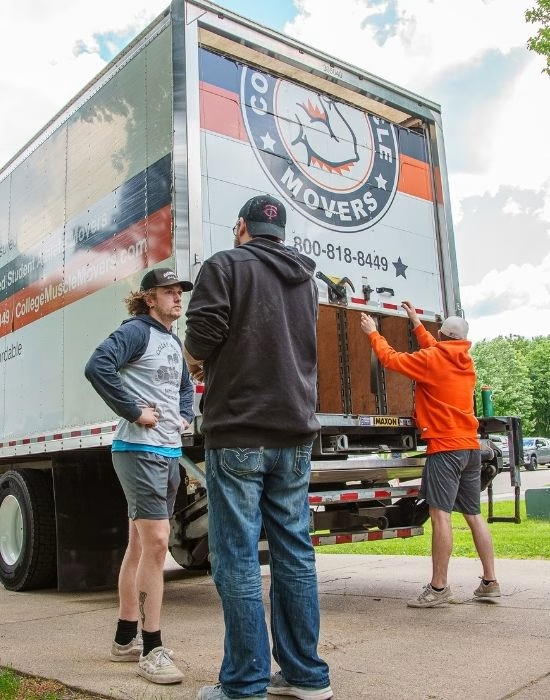
With a self-haul move, the crew that loads your belongings also drives them to your new home and unloads them. Many long distance moves are quoted as a fixed bid instead of an hourly rate, so you know the full cost before moving day and don’t have to worry about how long loading, driving, and unloading end up taking. Self-haul pricing also doesn’t depend on the weight of your shipment.
Our crews have driven loads to destinations across Wisconsin, Iowa, Nebraska, North Dakota, Illinois, and Missouri. One recent job was a long-haul unload in Mandan, North Dakota, with roughly 13 hours of driving involved. Others took crews roughly 400 to 475 miles each way, to Chicago, Lincoln, Nebraska, and Columbia, Missouri, some with overnight stays along the way. Self-haul makes the most sense at regional distances, from a few hours’ drive to a full day on the road, where one crew and one truck can handle everything.
Van Line: Local Loading, National Transport
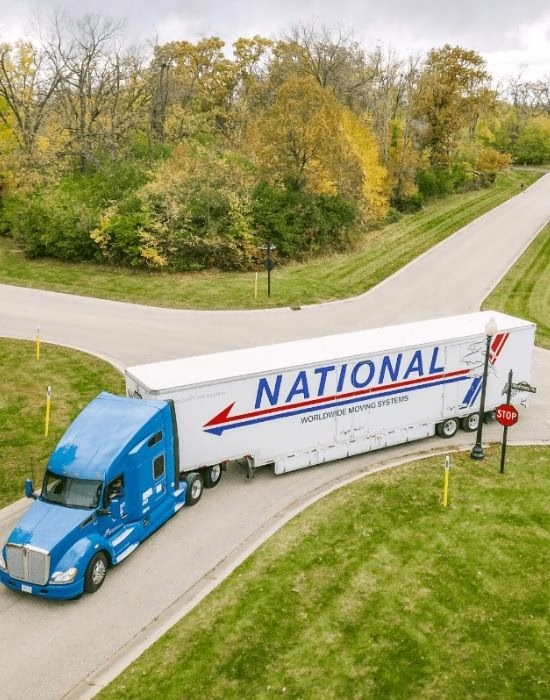
For longer distances, we work as an agent for National Van Lines. Our crew handles the Minnesota side, whether that means loading a shipment here or unloading one that arrives from out of state. National Van Lines handles the interstate transport under its own operating authority and prices that portion by weight and distance.
In some cases we handle only one end of the move. That split is common across the industry, and it explains why your loading day and your delivery day may involve different crews.
Portable Storage: Load Now, Deliver Later
Some long distance moves use a portable storage container that is packed at your home and transported separately, sometimes with a stretch of storage in between. This fits well when your move-in date isn’t set yet. It’s the same vault approach we describe in our guide to moving into a new home before you sell your old one, applied across a longer distance.
Long Distance Moving Cost From Minnesota: Real Price Ranges
The two main models are priced differently, so it helps to look at them separately.
What Self-Haul Moves Cost
Self-haul pricing comes down to two things: a travel fee based on the distance, and crew time based on the size of your inventory. Because many long distance moves are quoted as a fixed bid, you’ll typically know both numbers, and the total, before moving day. A move to a nearby state costs less than a move several states away, and a small apartment costs less to load and unload than a full house. Since travel fees and crew rates are adjusted over time, the most accurate way to know what your specific move will cost is to get a current quote rather than rely on a past example.
What Van Line Moves Cost
On van line moves, our portion for loading or unloading most often ran from a few hundred dollars to about $3,000, depending on the size of the shipment. The interstate transport is quoted separately by National Van Lines based on weight and distance, so ask for both numbers up front.
For orientation, Allied’s long distance cost calculator cites the American Moving & Storage Association’s average of about $4,300 to move a typical 7,400-pound household more than 1,000 miles. The same calculator shows ranges from roughly $2,200 to $10,500 for moves up to 400 miles, and $4,400 to $17,000 for cross-country moves.
Full-service moves that include packing and specialty items can run higher still. One quote we wrote for a three-bedroom home moving to Oklahoma City, with packing, home theater equipment, and antiques, came in between roughly $18,000 and $22,700.
The Short Version on Price
Self-haul moves to nearby states are generally the most affordable option, since you’re paying for one crew and one trip rather than a separate interstate carrier. Van line moves cost more as distance and shipment weight increase, and a full household moving across the country is the most expensive scenario. Because many long distance moves are quoted as a fixed bid, you can get the actual number for your move before you commit, which is the most reliable way to budget rather than relying on a past example. For a local comparison, see our guide to moving costs in the Twin Cities.
Where CMM Long Distance Customers Actually Move
We looked back through jobs where our crews handled the loading or unloading side of a long distance move, and the pattern was pretty spread out. Destinations covered 19 states, including Illinois, Missouri, Iowa, Texas, California, Florida, Arizona, Washington, New York, and Massachusetts.
Roughly half of those moves went to a neighboring Midwest state, and roughly half went considerably farther. That list includes self-haul jobs, such as our trips to Chicago, Lincoln, Nebraska, and Columbia, Missouri, and it doesn’t count the regional self-haul moves into Wisconsin and North Dakota described above. Whether you’re headed two states over or across the country, this is a move we do regularly.
How to Choose Between Self-Haul, Van Line, or Portable Storage
A few rules of thumb from the jobs we see:
- Within about a day’s drive, or a bit more: self-haul is often the simplest option. One crew handles everything, and many jobs are quoted as a fixed bid so you know the full cost up front.
- Farther away or a large household: a van line usually makes more sense, since weight-based pricing and a national network are built for long hauls.
- Move-in date not set: portable storage lets you load now and deliver when you’re ready.
Whichever route you take, vet the company carefully. Our guides to choosing a moving company and moving company red flags apply just as much to long distance moves.
How to Prepare for a Long Distance Move From Minnesota
A few things matter more here than on a local move:
- Declutter before you get a quote. Van line pricing is based on weight, and self-haul quotes reflect the size of the load and the trip, so moving less lowers your quote either way. Our moving checklist has a full timeline.
- Plan around a delivery window for van line moves. Shipments typically arrive within a range of days, especially when combined with other households heading the same direction.
- Ask whether your price is a fixed bid. A fixed bid, also called a binding estimate, means you know the full cost up front. A non-binding estimate can change based on your shipment’s actual weight.
- Know your rights as an interstate shipper. The Federal Motor Carrier Safety Administration requires interstate movers to provide a booklet on your rights and responsibilities. You can review it on FMCSA’s consumer protection page.
A Mover’s Perspective On Long Distance Moves
Long distance days have a different rhythm than local ones. On a van line load, everything is inventoried and often numbered as it goes on the truck, since it may travel alongside other households’ belongings. On a long-haul unload like the Mandan job, the move itself was short and most of the day was the drive. In both cases, a clear inventory settled ahead of time keeps the day smooth for the crew and for you.
FAQs About Long Distance Moves
How do long distance movers from Minnesota work?
Long distance moves generally follow one of three models. A local crew can self-haul the whole move, a national van line can handle the interstate transport while a local crew loads and unloads, or a portable storage container can be loaded at your home and transported separately. CMM offers all three.
How much does it cost to move long distance from Minnesota?
It depends on the model and the size of the move, and many long distance moves are quoted as a fixed bid so you know the total before moving day. In our records, regional self-haul moves most often cost between about $1,700 and $4,700. Van line moves are priced by weight and distance, and national benchmarks put a typical household moving 1,000 miles or more at around $4,300, with cross-country moves ranging from roughly $4,400 to $17,000.
Can a local moving company move me to another state?
Yes, at regional distances. Our crews have hauled loads to Wisconsin, Iowa, Nebraska, North Dakota, Illinois, and Missouri. For longer distances, we work with National Van Lines to handle the interstate transport.
How long does long distance delivery take?
Van line deliveries typically arrive within a window of several days rather than at a set time. Self-haul moves are delivered by the same crew that loaded them, on the schedule you agree on in advance.
Can I use portable storage for a long distance move?
Yes. A portable storage container can be loaded at your home and transported separately, which is useful if your move-in date isn’t finalized.
Long Distance Moving With an Experienced Team
Planning a long distance move from the Twin Cities? Learn more about our long distance moving services or start with our moving checklist to get organized.
About the Author

Morgan Alexander
Moving Specialist