
Voted Minnesota's
#1 Moving Company

How to Choose a Moving Company in the Twin Cities: What to Look for and What to Avoid

Before you hire movers, it’s important to learn how to choose a reliable moving company in the Twin Cities. Choosing the right movers is one of the most important decisions you’ll make. A great mover turns a stressful day into a smooth one. A bad one can damage your belongings, blow your budget, or in the worst cases, not show up at all.
The good news is that Minneapolis, St. Paul, and the Twin Cities metro have plenty of reputable, professional moving companies to choose from. Knowing the right questions to ask — and the red flags to watch for — goes a long way toward making sure you hire one of them. Here’s what to look for and what to avoid.
Quick Answer: How to choose a moving company in the Twin Cities
- Verify the company is fully licensed and insured — look for a USDOT and MNDOT license number — and has a strong, established Google review presence with several hundred reviews spanning multiple years.
- Get a detailed estimate based on a full inventory, not just your bedroom count. It should account for stairs, elevator use, parking distance, and disassembly needs — with a time range of about one hour.
- Confirm movers are employees, not subcontractors, that all supplies are included in your quote, and that all fees are itemized before you book. No surprise charges should appear at the end of your move.
Make Sure They’re Licensed and Insured
This is the first thing to verify — and it’s non-negotiable. Making sure your movers are licensed and insured is an important step in protecting yourself from a nightmare moving experience.
Professional moving companies operating in Minnesota are required to hold both a USDOT license number (issued by the federal Department of Transportation) and a MNDOT license number (issued by the Minnesota Department of Transportation). These licenses mean the company is registered with the appropriate regulatory authorities and held to a defined set of standards. Any legitimate moving company will have their license numbers displayed clearly on their website. If a company doesn’t have both licenses, that should be a dealbreaker.
Beyond licensing, a reputable mover carries three types of insurance coverage: general liability, which protects against damage to your home and property; cargo insurance, which covers your belongings in transit; and workers’ compensation, which means you’re not exposed to liability if a mover is injured on your property. Ask specifically about all three.
Operating without proper licensing and insurance is more common than most people realize — and the consequences of hiring an unlicensed mover can be severe. If something goes wrong, you may have no legal recourse and no coverage for your losses.
College Muscle Movers is fully licensed, bonded, and insured in Minnesota. We hold USDOT #1443087 and MNDOT #373531.
Check Their Reputation – Especially Google Reviews
Once you’ve confirmed a company is licensed, the next step is understanding their track record.
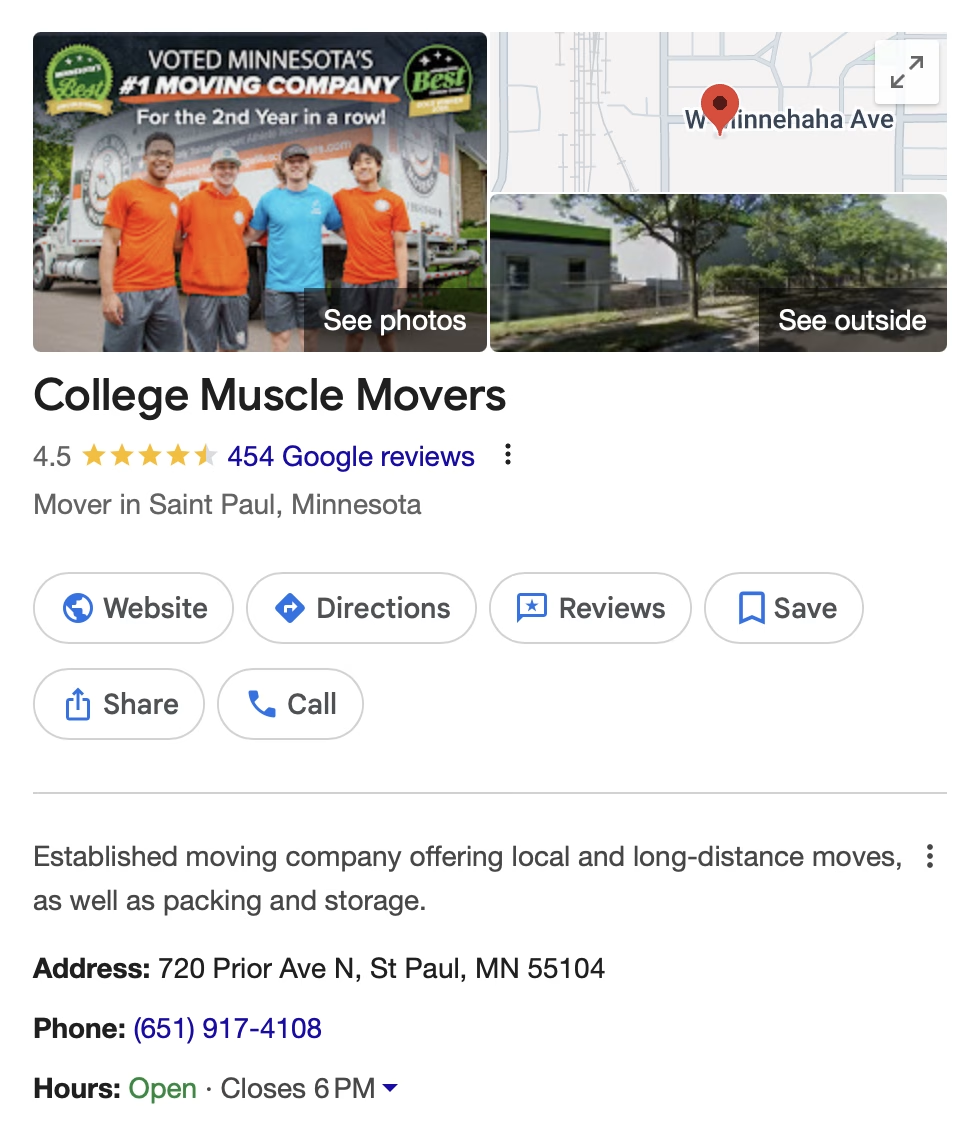
Google Business reviews are the most reliable public signal of a moving company’s quality. Look for a company with several hundred reviews, a consistently high rating, and a history that spans multiple years. A company with 400 reviews built over seven years is a very different proposition than one with 40 reviews from the last six months. Longevity matters — it means they’ve been doing this long enough to have a real track record and enough volume for the reviews to be meaningful.
Yelp and the Better Business Bureau are worth checking as secondary sources. And one counterintuitive thing to watch for: a company with exclusively five-star reviews and zero negative ones can be a warning sign. Legitimate review profiles have some critical feedback mixed in. A perfect score with no complaints often means reviews are being filtered or manipulated.
While you’re at it, take a look at their website. A professionally built site with original content and real photography signals an established, credible operation. A cheaply made site with stock photos and thin content often reflects the quality of the company behind it.
Evaluate Their Customer Service Before You Book
The quality of a moving company’s customer service before your move is one of the best predictors of how your moving day will go.
Call and speak to a representative. Are they knowledgeable about moving logistics? Do they ask detailed questions about your move, or do they just take down your address and bedroom count? Do they follow up in a timely way and stay in communication leading up to your move date?
At College Muscle Movers, we have a dedicated team of Service Coordinators available Monday through Friday to help estimate your costs, book your reservation, and answer any questions you have. After booking, you’ll receive an email confirmation with all of your moving details. Two to three business days before your move, we’ll call to check in, confirm your inventory, and make sure we have everything we need to avoid any surprises on moving day.
Ask specifically about arrival times. Some companies give you a wide window — “sometime between 8am and noon” — which makes it hard to plan your day. At College Muscle Movers, we give you a specific arrival time you can count on, backed by our On-Time Guarantee: if we arrive more than an hour late, you get $100 back.
Understand How They Estimate Your Costs – This is the Most Imporant Step
Of everything on this list, the quality of a company’s estimate process is the single most important thing to evaluate. Here’s why.
Almost all local moving estimates are non-binding, which means the final cost is based on the actual time and labor required to complete your move — not a fixed number agreed to in advance. Most licensed moving companies have a two-hour minimum. After that, you’re billed at the hourly rate until the job is complete, prorated to the next quarter hour.
This structure is completely standard and fair — but it means the accuracy of your estimate depends entirely on how thoroughly the moving company gathered information about your move upfront. A company that estimates your costs based only on your bedroom count and zip code is not giving you a real estimate. They’re giving you a guess. And when the actual move takes longer than guessed, the difference shows up on your final bill.
A thorough estimate requires all of the following:
- A full inventory of furniture and large items, plus an estimated box count
- Whether there are stairs or elevators at either location
- The carry distance from the building entrance to where the truck can park
- Whether furniture disassembly or reassembly will be needed
- Whether any items will still need to be boxed up on moving day
Without this information, a moving company simply cannot give you an accurate estimate. If they’re willing to quote you without it, that’s a red flag.
One specific thing to look for: the range on your estimate. A well-researched estimate for a local move should have a time range of approximately one hour — for example, 3 to 4 hours. If a company gives you a range of 3 to 6 hours, that’s not an estimate. That’s an acknowledgment that they don’t know — and it means your actual bill could land anywhere in that window.
At College Muscle Movers, we gather all of the information above before providing an estimate. You can go through the process over the phone with one of our Service Coordinators, fill out our Estimation Assistant online form at your own pace, or — for larger moves of 3 bedrooms or more — we recommend scheduling an in-person or virtual survey to make sure nothing gets missed. All costs, fees, and specialty handling charges are clearly itemized on your estimate before you book. There are no fees that appear for the first time at the end of your move.
For a full breakdown of what local moves cost in the Twin Cities, see our guide to moving costs.
Ask About Their Crew & Supplies
The people who show up on moving day matter as much as anything else on this list.
Ask whether the company’s movers are employees or subcontractors. This distinction matters more than most people realize. Employee-based crews go through company training, are held to company standards, and are accountable to the company in a way that subcontractors or day laborers simply aren’t. A company that staffs jobs with subcontractors or pulls from a day labor pool has less control over the quality and consistency of the crew that shows up at your door.
Ask whether movers undergo background checks. This is a basic standard for a company that’s sending people into your home.
At College Muscle Movers, all of our movers are full employees — not subcontractors or day laborers. Every employee undergoes a background check at the time of hiring and goes through extensive training before working independently. Every job has a crew lead with a minimum of one year of moving experience.
Also ask whether all equipment and supplies are included in your quote. Some moving companies charge separately for materials like shrink wrap — as much as $20 per roll — which can add up quickly on a larger move. At College Muscle Movers, all moving blankets, straps, dollies, and plastic shrink wrap needed to safely complete your move are included. No line items for basic supplies.

Ask About Their Trucks and Equipment
A company that owns its fleet is generally a more established, stable operation than one that rents trucks job by job. Ask whether the company owns the trucks they use.
At College Muscle Movers, we own our entire fleet of 26-foot and 16-foot box trucks. The truck size assigned to your move is matched to your inventory. If there’s any chance your belongings won’t fit in a single truck, we’ll let you know in advance and cost out the option of a two-truck service — so you can decide whether to move everything at once or handle the overflow yourself.
Ask specifically about specialty items. Pianos, gun safes, large exercise equipment, and antiques require proper handling and equipment, like a piano board, dollies, and moving straps. In some cases, these items incur additional fees to move. A quality mover should be able to answer clearly and specifically about how they handle these items and what the associated costs are. Vague or uncertain answers are a red flag.

Understand Their Valuation Coverage and Damage Policy
Before you book, ask directly: what happens if something is damaged or lost during my move?
A professional moving company will have a clear answer and defined options. The baseline coverage required by law is released value protection, which covers your belongings at a rate of 60 cents per pound — meaning a damaged 50-pound television would net you $30. That’s the floor, not the ceiling.
Quality movers offer additional valuation coverage options that provide greater protection for your belongings. At College Muscle Movers, we offer several Valuation Coverage plans so you can protect your belongings at the level that’s right for your situation.
Get the answer to this question before moving day — not after something goes wrong.
Know the Deposit and Cancellation Policy
Most reputable moving companies require a deposit to hold your date on their calendar. A deposit is actually a positive signal — it means the company is committed to showing up and has something at stake in the reservation just as you do. Be cautious of a company that doesn’t require any deposit at all.
At College Muscle Movers, deposits are fully refundable up until three business days before your moving date. After that window closes, the deposit becomes non-refundable, and rescheduling carries a $50 fee. This policy exists for two reasons: it gives you flexibility as a customer if your plans change, and it protects us from last-minute cancellations that leave our crew without work on a day they counted on having hours.
A word on moving scams: they’re real and worth knowing about. The most common ones include lowball estimates that inflate significantly on moving day, companies that demand full payment upfront before unloading your belongings, and in more extreme cases, hostage load situations where a company loads your belongings and then refuses to deliver them until you pay an amount higher than originally quoted. Working with a licensed, reputable mover with a strong review history is the best protection against all of these.
Moving Company Red Flags to Watch for in the Twin Cities
Every section above covers specific warning signs. Here’s the full list in one place — if you encounter any of these when evaluating a Twin Cities moving company, proceed with caution:
- No license numbers — a legitimate mover will have both a USDOT and MNDOT license number and will provide them without hesitation
- Few or recent-only reviews — a thin review history or one that only goes back a few months signals a company without a real track record
- No meaningful online presence — no website, no reviews, no way to verify legitimacy or hold the company accountable
- Estimate based on bedroom count only — a real estimate requires a full inventory, not just a room count
- Time range wider than one hour — a 3 to 6 hour estimate range isn’t an estimate, it’s an acknowledgment that the company doesn’t know the specifics of your move
- Subcontracted or day labor crews — less accountability, less consistency, less training
- No background checks — a company sending unvetted people into your home
- Charges for standard supplies — shrink wrap, blankets, and dollies should be included in local moves, not billed separately
- Rented trucks — often signals a less established operation
- Vague damage coverage answers — if they can’t clearly explain what happens when something breaks, that’s a problem
- No deposit required — counterintuitively, a company with no skin in the game is a higher risk
- Full payment demanded before delivery — a classic moving scam setup
Questions to Ask a Twin Cities Moving Company Before You Book
If you want a quick reference before making your decision, here are the most important questions to ask any moving company in the Twin Cities:
1. Are you licensed with a USDOT and MNDOT license number? Professional moving companies operating in Minnesota are required to hold both. Any legitimate company will provide these numbers without hesitation. If they can’t, that’s a dealbreaker.
2. What types of insurance do you carry? Look for general liability, cargo insurance, and workers’ compensation. All three matter — general liability covers your home, cargo covers your belongings, and workers’ compensation protects you if a mover is injured on your property.
3. Are your movers employees or subcontractors, and do you run background checks? Employee-based crews are trained, accountable, and held to company standards. Subcontractors and day laborers are not. Background checks are a basic standard for anyone entering your home.
4. How do you build your estimates — what information do you need from me? A legitimate estimate requires a full inventory, stair and elevator information, carry distance, and disassembly needs. If a company quotes you based on bedroom count alone, that’s a guess — not an estimate.
5. What is the time range on your estimate, and what fees are included? A well-researched estimate should have a range of approximately one hour. A range of 3 to 6 hours means the company doesn’t know enough about your move. All fees should be itemized before you book — nothing should appear for the first time on your final bill.
6. Do you own your trucks, and what size will be assigned to my move? A company that owns its fleet is a more established operation. Confirm the truck size will be matched to your inventory — and that you’ll be told in advance if a second truck might be needed.
7. What valuation coverage options do you offer? The legal minimum is 60 cents per pound — often far less than the actual value of damaged items. Ask what additional coverage plans are available before moving day, not after something goes wrong.
8. What is your deposit and cancellation policy? A deposit is a positive signal — it means the company has skin in the game. Confirm the refund window, any rescheduling fees, and make sure the policy is in writing before you commit.
Based on their answers, you’ll have a good sense of their moving experience and business practices.
Ready to Get a Quote From a Twin Cities Moving Company You Can Trust?
Choosing a moving company in the Twin Cities doesn’t have to be stressful. The metro has a strong market of professional movers — and if you run through the checklist above, you’ll be well positioned to find one that’s the right fit for your move. That said, not every company operating in the metro meets the standards above — knowing the red flags to watch for is just as important as knowing what good looks like.
At College Muscle Movers, we’re fully licensed, bonded, and insured, with a fleet of owned trucks, an all-employee crew that’s background checked and trained, and a dedicated team of Service Coordinators ready to help you build an accurate estimate from the ground up. We back every job with our On-Time Guarantee, and we provide a fully itemized estimate before you book — no surprises at the end of your move.
Request a free quote from College Muscle Movers and one of our Service Coordinators will walk you through the process. If you’d like to understand what a local move should cost before reaching out, our guide to moving costs in the Twin Cities breaks it all down. And if you’re still weighing whether to hire movers at all, our guide to hiring movers vs. doing it yourself can help you think through the decision.
About the Author

Morgan Alexander
Moving Specialist