
Voted Minnesota's
#1 Moving Company

Moving Into an Apartment in Minneapolis or St. Paul: What You Need to Know
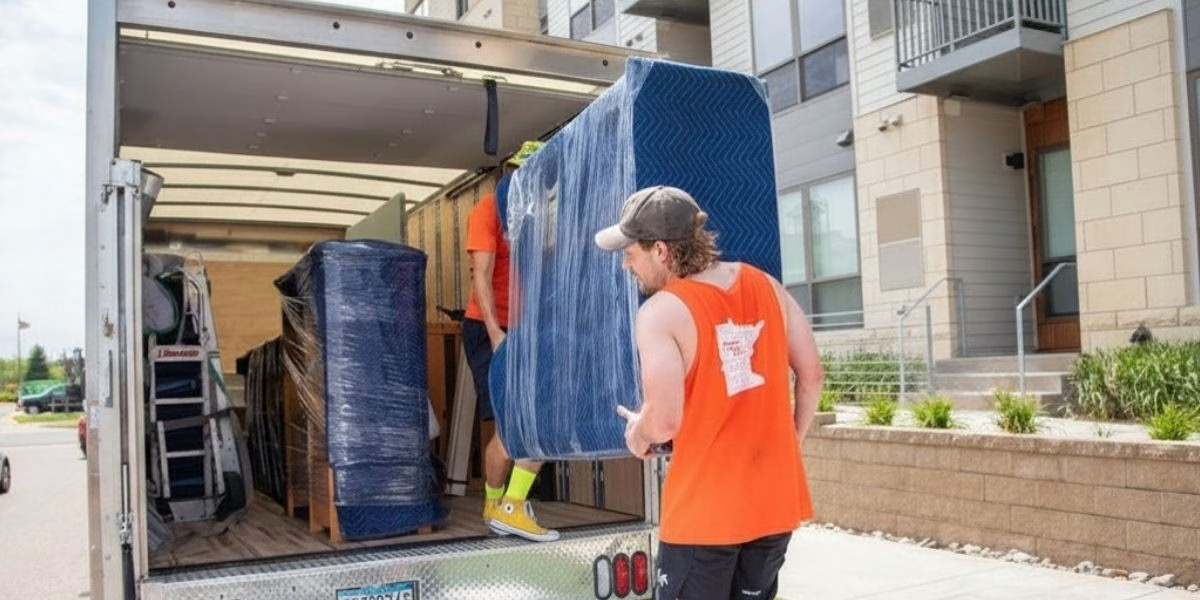
When you’re moving into an apartment in Minneapolis or St. Paul, it’s best not to go in blind. You don’t want to be caught off guard on moving day by some logistical obstacle that could have been avoided.
At College Muscle Movers, we’ve moved people into and out of thousands of apartments across the Twin Cities, and we can tell you just about everything you need to know. From parking to elevators and building rules, apartment moves have their own unique set of challenges.
Apartment moves don’t have to be stressful, though. This guide walks through what to check with your building, how parking and elevators can impact your move, and how to avoid the mistakes that make your moving day feel chaotic and time-consuming.
Moving Into an Apartment in Minneapolis or St. Paul: The Short Version
Moving into an apartment in Minneapolis or St. Paul involves logistics a house move usually doesn’t: elevator reservations, loading dock scheduling, parking permits, and building-specific rules that vary from one property to the next. A few things make the biggest difference:
- Confirm your building’s move-in policy with your leasing office before booking movers, including elevator reservations, loading dock hours, and any certificate of insurance requirement.
- Check what kind of parking is available at both your old and new address. Some buildings have a loading dock that can be reserved, while others Parking lots and street parking are far more common at apartments than driveways.
- If your building has an elevator, ask if it can be reserved in advance. When you’re paying by the hour, you don’t want to your movers to have to wait for the elevator.
- Ask about move-in time windows. Some buildings restrict moves to certain hours or days.
- Budget extra time for carry distance. A long walk from the parking area to your door adds to your total move time even when there are no stairs involved.
- If you’re moving from one unit to another within the same building, it can still be worth it to hire movers. Moving crews have dollies, carts, and expertise that allows them to get the job done fast.
The sections below cover each of these with real numbers from our own move history.
What Moving Into an Apartment in Minneapolis or St. Paul Actually Involves
Apartment moves come with logistics a house move usually doesn’t have. House moves tend to involve short carry distances and few unknowns. Apartment moves often mean long hallways, elevators or flights of stairs, and working around other residents the whole time.
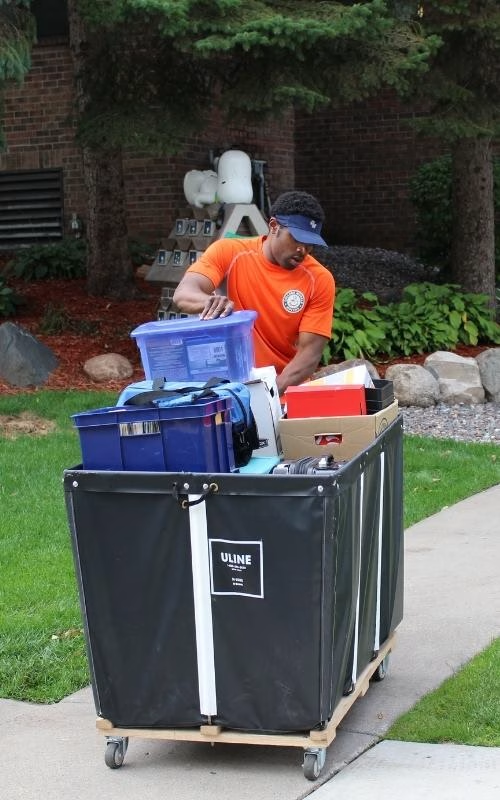
Professional movers often make an apartment move look easy, and that comes down to experience and having the right tools for the job. At CMM, we don’t just pad and wrap your furniture. We use dollies and carts that let us move items quickly down long hallways and into elevators. Carry those same items one by one instead, and the job turns into hours of exhausting work.
That same experience is what keeps large furniture from damaging hallway walls and door frames along the way. Navigating a dolly loaded with a couch or dresser through a narrow hallway takes practice, not just strength, and it’s usually the difference between a clean move and a scuffed-up wall.
Most apartment moves also work more efficiently with more than two movers on the crew. With an extra mover or two, one team can prep items and send them down the hallway or elevator while the other loads the truck, rather than one crew handling both ends of the job in sequence. Our own data backs this up: the average apartment move on our books uses more than two movers, closer to two and a half, which lines up with how much of this relay-style coordination an apartment move actually needs.
Parking: What to Expect Before Your Movers Arrive
Parking looks different at an apartment than it does at a house. Across the apartment moves in our records, parking lots and street parking account for the large majority of access points, and driveways barely factor in at all, the opposite of what you’d typically see at a single-family home.
Street parking brings its own wrinkle in Minneapolis specifically. In several parts of the city, particularly downtown, the North Loop, and Uptown, a temporary obstruction permit is required to legally park a moving truck close to your building. Without one, your truck may need to park farther away, which adds real time and real cost to an hourly-billed move. You can apply for a Minneapolis temporary obstruction permit online through the city’s website, and we recommend doing this as soon as your move date is confirmed.
St. Paul has its own equivalent: an obstruction permit issued through the city’s PAULIE platform, which covers parking lane use and parking meter hooding, the two scenarios most relevant to a moving truck. Applications require proof of insurance naming the city as an additional insured, so this is worth handling with enough lead time rather than the day before your move.
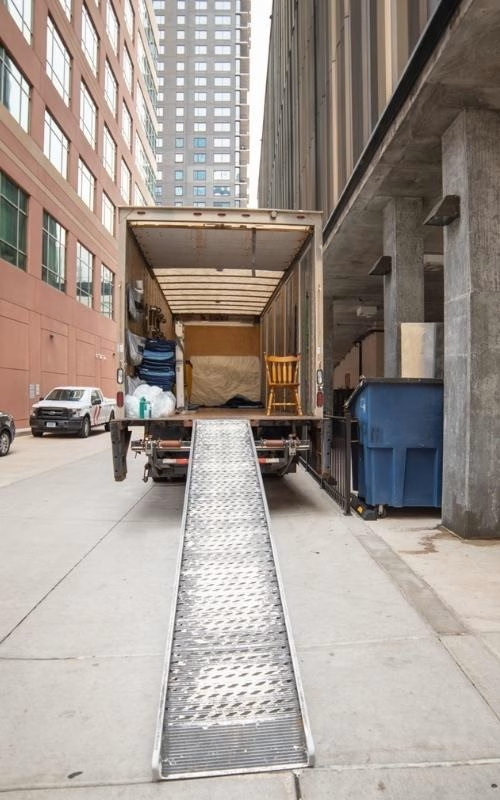
Loading docks solve a lot of this for buildings that have them, but they usually come with their own scheduling window, which is worth confirming early. More on that below.
Make Sure to Reserve the Elevator for Your Apartment Move
More than half of the apartment moves we’ve completed involve using an elevator to reach the unit, and it’s rarely optional given how many Twin Cities apartment buildings are mid-rise or high-rise construction.
What catches people off guard is the reservation requirement. About 1 in 10 apartment moves we handle need the elevator reserved in advance. That’s different from simply having an elevator available: a reservation means the building blocks off a window of time where that elevator is set aside for your move and unavailable to other residents. Buildings vary widely on how far ahead they need this request; some ask for 24 hours, others want a week or more.
A single bottleneck can throw the whole schedule off by hours. On one move I was on, the customer lived many floors up in a 2-bedroom unit, and we brought a 4-person crew because of the size of the inventory, a large book collection and several pieces of heavy wooden furniture. A bigger crew often pays off in exactly this kind of situation: two movers load dollies and basket trucks onto the elevator while the other two unload at the truck and secure everything for transport, so the elevator never sits idle waiting on one team to catch up.
This particular building didn’t allow elevator reservations, and with the unit so high up, each ride took over a minute, on top of sharing the car with other residents coming and going. We adapted by staging boxes and furniture near the elevator ahead of time, loading it fully in one trip, then having the second team pull everything out and load the truck while the first team staged the next load. That kind of coordination is often the difference between a move that stays on schedule and one that doesn’t, especially in a building where reserving the elevator isn’t an option.
Freight elevators, where a building has one, are sometimes required specifically for moves rather than the standard passenger elevator, and those often come with their own separate reservation process. If you’re not sure which applies to your building, your leasing office or property manager will know, and it’s worth asking before your move date rather than on it.
For buildings without an elevator, stairs are the default, and carry distance matters as much as flight count. A short carry up two flights can move faster than a long carry across a single floor to a distant unit. Long carries and tight stairwells are also where a lot of move-day damage happens; our breakdown of what gets damaged most during a move covers how to protect against it.

Apartment Building Move-Out Rules That Catch Renters Off-Guard
Every apartment building sets its own move-in rules, and they’re rarely posted anywhere obvious until you ask.
Certificates of insurance. Many larger buildings, especially those with a dedicated property management company, require a certificate of insurance (COI) from your moving company before they’ll allow access to a loading dock or freight elevator. This isn’t something you need to create yourself; a legitimate moving company can provide one on request, but it needs to happen before move day, not the morning of.
Move-in time windows. Some buildings restrict moves to certain hours, certain days of the week, or block out weekends entirely. Confirm this before you book your movers, not after.
Loading dock scheduling. Buildings with a loading dock usually require a scheduled window rather than first-come, first-served access, and that window needs to line up with when your movers actually arrive.
Hallway and elevator protection. Some buildings require padding on elevator walls or hallway corners during a move, and may either charge a fee for it or provide their own that you’re required to use.
None of these rules are unusual on their own. What causes problems is finding out about them the week of your move instead of the month before.
Internal Moves: A Different Kind of Apartment Move
What to Confirm With Your Leasing Office Before Moving Day
Before you book your movers, a short conversation with your building’s leasing office or property manager can save you from the most common apartment move-day problems:
- Does the elevator need to be reserved, and how far in advance?
- Is there a loading dock, and does it require a scheduled window?
- Does the building require a certificate of insurance from your movers?
- Are there restricted move-in hours or days?
- Is street parking realistic, or does the building recommend a specific area or permit?
- Is hallway or elevator padding required, and does the building provide it?
Get these answers before you book, and pass them along to your moving company when you schedule. A company that asks these questions during your estimate is planning for your actual building, not guessing. If you’re still comparing movers, our guide to choosing a moving company in the Twin Cities covers exactly what to ask before you book, and our moving checklist walks through the full timeline from booking to move day.
How to Get Your Security Deposit Back
Most Minneapolis and St. Paul leases require you to leave your old unit in clean condition to recover your security deposit, and that’s easy to overlook when you’re focused entirely on the new place. Keepsake PCO specializes in move-out cleaning and can coordinate directly with your move date, so your old unit is ready for its final walkthrough without adding another task to your week.
FAQs About Moving Into an Apartment in Minneapolis or St. Paul
Do I need to reserve the elevator for my apartment move?
It depends on the building. About 1 in 10 of the apartment moves we complete require an advance elevator reservation, and buildings vary widely on how much notice they need, anywhere from 24 hours to a week or more. Check with your leasing office as soon as your move date is set.
Do I need a permit to park a moving truck in Minneapolis or St. Paul?
In several parts of Minneapolis, particularly downtown, the North Loop, and Uptown, a temporary obstruction permit is required to park a moving truck close to your building. St. Paul has a similar process, an obstruction permit issued through the city’s PAULIE platform, covering parking lane use and meter hooding. Both can typically be applied for online, and it’s worth doing as soon as your move date is confirmed rather than waiting until the week of your move.
What is a certificate of insurance, and do I need one for my apartment move?
A certificate of insurance (COI) is a document from your moving company’s insurer confirming coverage, and many larger apartment buildings require one before allowing access to a loading dock or freight elevator. Your moving company can provide this on request, but ask early, not the week of your move.
What is an internal move?
An internal move is a relocation from one unit to another within the same building. It still requires coordination with building management and often the same hallways and elevators as a standard move, and most movers price and schedule it differently than a move to a new address.
How much does an apartment move cost in the Twin Cities?
Cost depends primarily on the size of the apartment, stairs or elevator use, and carry distance. Our guide to moving costs in the Twin Cities breaks down the full range by home size.
What makes an apartment move take longer than expected?
Ease of access to your unit matters more than the volume of items. Elevator use, a reserved elevator window, stairs, and a long carry distance from the parking area to your door all add real time to a move regardless of how much you’re bringing. An accurate estimate needs to account for your specific building, not just your unit size.
What equipment do I need to move heavy furniture?
For most moves: furniture sliders, moving blankets, stretch wrap, and lifting straps. For appliances: an appliance dolly. For pianos: a piano board. For extremely heavy items, consider whether a professional crew is the right call.
When should you hire professional movers instead of doing it yoursefl?
When the move involves stairs, items weighing several hundred pounds, pianos, gun safes, commercial gym equipment, or anything where a mistake could cause serious injury or irreparable damage to your home or belongings.
Hire Experienced Apartment Movers
The biggest difference between a smooth apartment move and a stressful one usually comes down to what happened before move day: whether the elevator was reserved, whether the leasing office knew to expect you, whether parking was sorted out in advance.
At College Muscle Movers, we’ve moved thousands of customers into apartments all across the Minneapolis and St. Paul. Every move comes with the right tools and equipment to make your apartment move smooth and efficient.
Get a quote today and a service coordinator will be in touch shortly.
About the Author

Morgan Alexander
Moving Specialist