
Voted Minnesota's
#1 Moving Company

Office Moving Costs in the Twin Cities: Data From 250+ Moves

Office moving costs in the Twin Cities mostly come down to three things: how many movers the job needs, how hard the buildings are to load and unload, and how much furniture has to be taken apart and put back together. To put real numbers on that, we reviewed 254 office and business moves from our own records, covering the last several years across Minneapolis, St. Paul, and the surrounding suburbs.
These office moves included full relocations, partial moves, and moving furniture internally from one room to another. This guide shares what we found, from crew sizes and timelines to price ranges, and then walks through a planning checklist built around the details that come up most often in our crew notes. College Muscle Movers has been locally owned and operated in St. Paul since 2008, and if you would rather skip straight to a quote, our commercial moving services team can help.
Office Moving Costs in the Twin Cities: The Short Version
- Full office relocations: The median cost was $1,100 to $1,500, based on 38 jobs. The average high-end estimate was about $2,540 because a few large moves pull it up, and the range ran from $543 to $13,510. Most used three movers for about four and a half hours.
- Everything else: About 35% of office moves inovlved moving furniture within the same building, 26% moving furniture in or out (new furniture delivered, old furniture removed, or a few pieces moved between buildings), and 21% were other business moves such as warehouse inventory, equipment, and event supplies.
- Pricing: The total cost can depends on the size and complexity of the job. Most moving companies, including CMM, charge by the hour, though some office moves involve a fixed price negotiated by both parties.
- Booking: The median job was booked about two or three weeks ahead, and full relocations about four days ahead.
How Much Does It Cost to Move an Office in the Twin Cities?
A full office relocation, where a business moves everything to a new space, had a median estimate of $1,076 to $1,402 in our records. Some of our commercial work is smaller in scope, so it helps to know which type of move you are pricing.
The overall range in price of office moves is quite large, from less than $1,000 to $15,000 or more. Since prices can vary so much, we grouped our office moves into a few categories.
| Job type | Typical crew | Typical time | Typical estimate |
|---|---|---|---|
| Full office relocation (a whole office moves to a new space) | 4 movers | 6.5 hours | $1,100 to $2,100 |
| Moving furniture within the same building | 3 movers | 2 hours | $550 to $700 |
| Furniture in or out (new furniture delivered, old furniture removed, or a few pieces moved between buildings) | 2 movers | 1.75 hours | $400 to $600 |
| Other business moves (warehouse inventory, equipment, event supplies, records) | 2 movers | 4.6 hours | $900 to $1,300 |
Typical values are medians, and each estimate runs from the low end to the high end of our quoted range.
What Does a Full Office Relocation Cost?
Most full relocations were small offices. Of the 38 we reviewed, 23 used two or three movers, and the cost climbs quickly as crew size and time on site grow.
| Size of relocation | Typical time | Range |
|---|---|---|
| 2 to 3 movers (small office) | 3.25 hours | $543 to $2,037 |
| 4 to 6 movers (mid-sized office) | 6.25 hours | $1,877 to $3,851 |
| 7 or more movers (large office) | 8 to 24 hours | $6,825 to $13,510 |
What Does a Small Office Move Cost in the Twin Cities?
A small office relocation in Minneapolis or St. Paul with two or three movers had a median high-end estimate of $996. About half of those jobs came in at $1,000 or less, and 96% came in at $1,500 or less. Many smaller jobs are not relocations at all: moving furniture within one building had a median estimate of $537 to $700, and bringing in new furniture, taking out old furniture, or moving a few pieces between buildings had a median estimate of $398 to $578.
If you are building a budget, plan around the high-end figure for your move type and add the costs that sit outside the move, such as new furniture, IT setup, and signage. For larger or more complicated moves, we offer on-site estimates with our Senior Relocation Specialist.
What Impacts the Price of an Office Move?
Labor hours drive most of the price, and the buildings on either end have a big say in how many hours a job takes. Our records point to six factors.
The amount of items involved. More items means more time or movers needed to handle them. Our crews come equipped with carts, dollies, and other equipment to make moving through office halways and elevators as efficient as possible.
Elevators, docks, and stairs. In 39% of jobs there was an elevator at the pickup or the drop-off, in 15% at least one end used a freight elevator, and in 27% a loading dock was involved. Slow or shared elevators add time: on one office move, we built extra hours into the schedule because the two elevators in the building were slow.
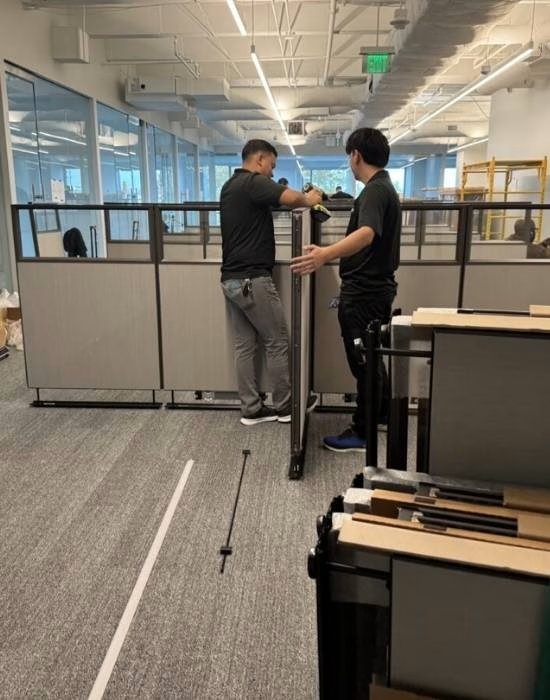
Disassembly and reassembly. Our movers carry a simple tool bag and can handle straightforward disassembly and reassembly, such as desks, table legs, and removing mirrors from dressers. They cannot remove doors or disconnect water or gas lines, so that work has to happen before moving day, and they cannot disassemble or reassemble exercise equipment. For specialty items such as cubicles, our partner Fixie Home Improvement can take them down and put them back up.
Heavy or specialty items. Tool chests, machinery, and safes call for extra planning. Some of our commercial moves involve palletized items that need to be moved using a pallet jack. It’s important to make sure all the necessary equipment is on hand to prevent delays.
Access and building rules. Security gates, ID checks, and access instructions came up in nearly one out of ten office jobs. On one job, all of our movers had to show valid ID at a loading dock gate, and their names had to be sent to the customer before the crew left for the job. If your building requires a certificate of insurance, we are happy to provide one on request.
Parking and distance. Most office moves are short hops: 73% of jobs started and ended in the same city, and about 66% started in Minneapolis or St. Paul. At pickup, 61% of jobs loaded from a parking lot, 21% from the street, and 17% from a loading dock, and street loading means space for the truck has to be arranged ahead of time.
How Long Does an Office Move Take?
Some office moves take a few hours, and many of them fit inside one day. Smaller office moves can take roughly half a day, while most mid-sized offices can be moved within a full day with the right crew size. On the high end, large office relocations can span multiple days. In our experience, about 90% were handled in a single service day.
The day of the week matters for scheduling. About 93% of jobs started Monday through Friday, with Tuesday the most common day at 23%. Weekend moves are usually available at the same rates as weekdays, though office moves are typically conducted during the work week.
The season matters too. In 2023 through 2025, July (13%) and January (12%) were the busiest months for new jobs, while October (4%) and November (3%) were the quietest. If your date is flexible, a late fall move usually means more scheduling choices, though a sample this size cannot explain why demand rises and falls.
How Far in Advance Should You Book an Office Move?
Book as soon as your move date is firm. On average, office moves tend to be booked about two or three weeks in advance, though it’s best not to leave it to the last minute.
If you are moving a small office, it may be possible to schedule as short as a week in advance. Larger office moves should be given more lead time. If you are moving a large office, we recommend reaching out at least four weeks ahead of your planned move date. That will give you a good chance that your preferred movers can fit you into their schedule.
Booking early also gives you more choice on the date and on elevator or dock times.

What Kind of Businesses Hire Office Movers
Office moves come from a wider mix of businesses than the word office suggests. Among over 200 office moves, 28% were food, beverage, retail, and consumer product businesses, 23% were warehouse, manufacturing, or technical equipment businesses, 21% were nonprofits, schools, and community organizations, 15% were law, finance, insurance, and other professional offices, and 13% were healthcare, wellness, and personal care practices. About one in five businesses hired us for more than one job.
Office Relocation Checklist for a Twin Cities Move
Start with the tasks that take weeks, then work toward moving day. Shift the timing to fit your lease dates.
Two to three months out
- Read your current lease for move-out requirements, restoration obligations, and notice deadlines.
- Ask the property manager at the new building about move-in rules: elevator reservations, loading dock hours, and any insurance paperwork the building requires from movers.
- Choose one point of contact to coordinate with the building, your movers, and your IT provider.
- Collect at least two written estimates and ask what the high-end figure includes. For a larger or more complicated move, ask for an on-site estimate.
- Book the move date as soon as it is firm, then book the elevator or dock window that goes with it.
One month out
- Decide what is not coming along. Every item you keep has to be carried, so sell, donate, or dispose of old furniture first. Our guide to what to do with unwanted furniture in the Twin Cities covers donation, recycling, and city pickup rules, and our furniture disposal service can haul away what is left during the move.
- Send the movers a floor plan of the new space and label each desk, room, and storage area to match it.
- Schedule your IT provider to disconnect and reconnect servers, phones, and network equipment. Plan on that work staying with your IT team.
- Plan for specialty furniture. Our movers handle straightforward disassembly such as desks and table legs, and Fixie Home Improvement can take down and rebuild cubicles.
- Order boxes or reusable crates. Our Muscle Boxes are $2.50 each, with 15 free when you book a move, and their handles and stackable design help with files and supplies.
Two weeks out
- Update your business address with the agencies and vendors that need it:
- If your registered office is changing, file a change with the Minnesota Secretary of State.
- Use IRS Form 8822-B to report a new business mailing address or location.
- Update your bank, insurer, key vendors, website, and Google Business Profile.
- Tell clients and staff the new address and the move dates.
- Ask staff to pack personal items and desk contents in labeled containers.
Moving week
- Walk the crew lead through both spaces. Point out what is fragile, what stays, and where each labeled item goes.
- Confirm access in advance: keys, fobs, gate IDs, and elevator times.
- Back up your data and carry laptops, valuables, and sensitive documents yourself.
After the move
- Walk both locations with the crew lead and check that furniture matches the floor plan. Report any damage right away.
- Handle repairs and finishing work at the old and new spaces, such as patching walls, mounting TVs, and assembling furniture. Fixie Home Improvement handles those jobs for Dwell Home Services customers.
- Return keys and fobs, and take photos of the old space for your records.
What to Ask an Office Moving Company Before You Hire
The right questions up front prevent most surprises on moving day. Ask each company you are considering:
- Are you licensed and insured? Ask for the company’s USDOT number and look it up in the FMCSA company snapshot. Also ask whether they can send a certificate of insurance, since some buildings want one before movers are allowed in. We are happy to provide one on request.
- How is the estimate built? Find out the hourly rate, what counts as billable (we charge $70 per mover and per truck per hour), what the minimum is, and what is included versus extra, such as disposal, disassembly, and packing.
- What can the movers take apart and put back together? Most movers can handle simple disassembly such as desks and table legs, but cubicles and other systems furniture often need a specialist. Ask what the crew will do and who handles the rest.
- How do you handle building rules? Elevator reservations, dock schedules, and ID checks are routine in downtown and suburban office buildings. A mover who asks about them early has done this before.
- What protection is there if something is damaged? Minnesota requires movers to provide basic valuation coverage at no cost, which pays $0.60 per pound. Ask about upgrades. We offer several valuation coverage plans beyond the state minimum.
- What happens if you are late? Ask about arrival windows and what the mover does if a crew runs behind. Our On-Time Guarantee takes $100 off your move if we are an hour or more late.
- How do you handle winter moves? From December through March, ask how the crew protects floors at entrances and handles snow and ice at the dock.
How to Keep Office Moving Costs Low
Moving fewer items and removing delays on site are the two reliable ways to shorten a job. These steps help most:
- Share an accurate inventory. Send photos and a count of desks, file cabinets, shelving, and anything heavy. Good information lets the estimator size the crew and the time correctly, and most of our jobs needed only two or three movers.
- Get rid of what you will not use. Every item you keep gets carried, so donate, sell, or dispose of old furniture first. We offer furniture disposal for unwanted items, and about 1 in 9 of our jobs included hauling something away.
- Reserve the elevator and dock ahead of time. Waiting on a freight elevator is paid time. Confirm the window with the property manager before you lock in the date.
- Label everything to match the floor plan. Crews unload faster when every desk, crate, and cabinet already has a destination.
- Pack small items before moving day. Staff can box desk contents and supplies in labeled containers, or you can hire a packing service so the crew is not waiting on unfinished boxes.
- Clear the path. Cables, supplies, and personal items left on desks slow everyone down, so a quick sweep the afternoon before pays off.
Planning an Office Move With College Muscle Movers
College Muscle Movers is a locally owned moving company at 720 Prior Ave N in St. Paul, voted Minnesota’s Best Moving Company in 2024, 2025, and 2026. We are licensed and insured (USDOT #1443087, MNDOT #373531), we provide a certificate of insurance on request, and our commercial moving services crews handle office moves across Minneapolis, St. Paul, and the surrounding suburbs. For larger moves we offer on-site estimates, and for any move you can call (651) 917-4108 or request a quote.
FAQs About Office Moves in Minneapolis and St. Paul
How much does it cost to move an office in the Twin Cities?
Office moving costs vary based on the size and complexity of the job. Based on our records, full office relocations can range from less than $1,000 on the low end to as high as $15,000 for large projects. Contact us for a personalized estimate.
How long does an office move take?
Full relocations took a median of 6.5 hours, and about 68% of all the jobs in our records took 6 hours or less. Larger offices, slow elevators, and furniture that must be disassembled are what stretch a job into a full day or more.
How far in advance should I book office movers?
Book as soon as your move date is firm. The median job in our records was booked about two weeks ahead and full office relocations about 20 days ahead, and some larger relocations were booked two months out. Early booking also gives you more choice on the date and on elevator or dock times.
Can movers disassemble and reassemble office furniture?
Yes, within limits. Our movers carry a simple tool bag and can handle straightforward disassembly and reassembly, such as desks and table legs. They cannot remove doors, disconnect water or gas lines, or disassemble exercise equipment, so that work has to be done before the movers arrive. Fixie Home Improvement can disassemble and reassemble specialty items like cubicles.
What should I do with old office furniture before a move?
College Muscle Movers offers furniture disposal for unwanted items, so we can haul away old furniture as part of your move. If the pieces are in good shape, donation is another option, and our guide to what to do with unwanted furniture in the Twin Cities walks through donation, recycling, and city pickup rules.
Do you provide a certificate of insurance?
Yes. We are happy to provide a certificate of insurance on request, which some buildings require before movers can enter. We also offer several valuation coverage plans beyond the free state minimum, so ask about them when you request your quote.
About the Author

Morgan Alexander
Moving Specialist