
Voted Minnesota’s #1 Moving Company

How Long Does it Take to Move?
A Realistic Timeline by Home Size
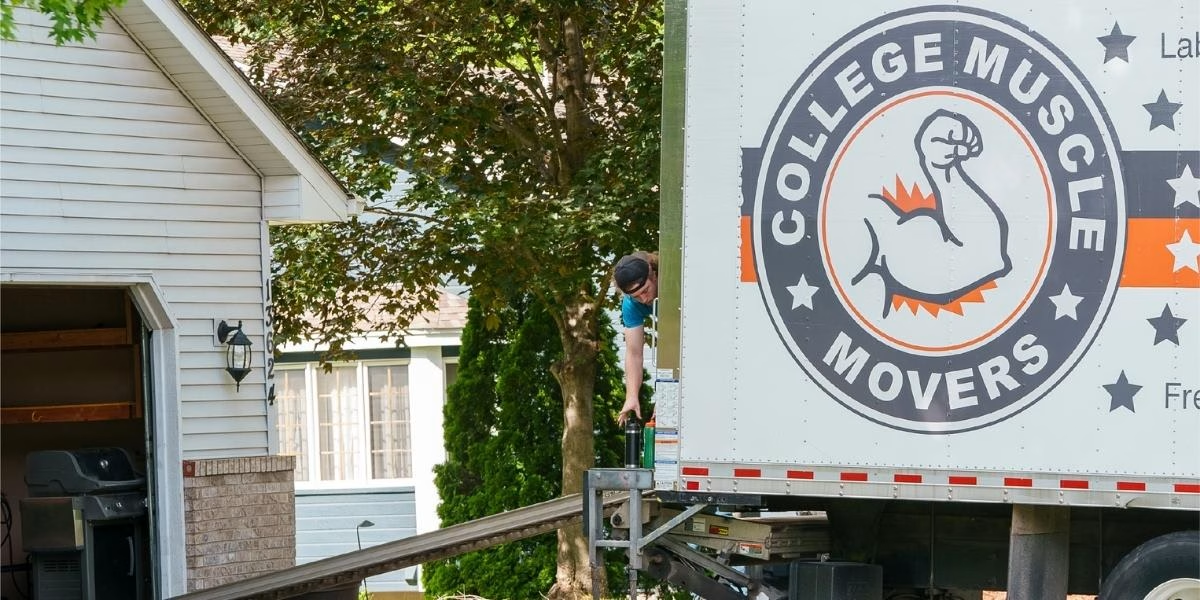
A local move can take anywhere from a few hours to a full day — and when you’re in the planning stage, knowing what to expect makes a big difference. Actual moving time depends on the size of your home and a handful of logistical factors that vary from move to move.
In this guide, we drew on five years of College Muscle Movers’ own move data to show how long moves of different sizes actually take. Along the way, we’ll break down the factors that influence your timeline so you can plan your moving day with confidence — and without surprises.
What affects how long a move takes?
Moving time isn’t determined by bedroom count alone. Several variables combine to shape how long your move will actually take:
Volume and size of items
The more you’re moving — and the larger and heavier the individual pieces — the longer it takes. A home with a piano, a sectional sofa, and a full garage is a different job than one with minimal furniture and a dozen boxes.
Carry distance at each location
This is the distance movers travel between your front door and the truck. A ground-floor unit with parking right out front moves much faster than a third-floor walkup with a loading zone at the end of the block. The same principle applies at the destination.
Logistical challenges
Flights of stairs, elevators that need to be reserved, tight hallways and sharp turns, and even weather conditions all affect pace. A narrow staircase might mean items have to be carried at an angle or taken apart and reassembled. An elevator building requires coordinating timing across multiple trips.
Drive time between locations
Once the truck is loaded, the driving time between your old and new home is added to your total move time. A local move within the same neighborhood and a move across the Twin Cities metro can differ by an hour or more just in transit.

Tight turns or stairs can cause bottlenecks that slow a move down.
How Long Does a Move Take By Home Size?
To give you a more concrete sense of what to expect, we pulled data from College Muscle Movers’ own move history going back five years. The figures below are based on thousands of local moves around the Twin Cities.
| Home Size | Avg. Crew Size | Moving Hours |
| Studio | 2 | ~2.3 hrs |
| 1 Bedroom | 2-3 | ~3.0 hrs |
| 2 Bedroom | 3 | ~3.8 hrs |
| 3 Bedroom | 3-4 | ~4.9 hrs |
| 4 Bedroom | 4 | ~5.6 hrs |
| 5+ Bedroom | 4-5 | ~7.2 hrs |

As a rough guide, moving a studio apartment typically takes a crew of 2 movers about 2 to 2.5 hours. A one-bedroom move runs around 3 hours with a crew of 2 to 3. For a two-bedroom, expect roughly 3.5 to 4 hours with 3 movers. Three-bedroom homes generally take a crew of 3 to 4 movers about 4.5 to 5 hours. A four-bedroom home runs 5.5 to 6 hours with 4 movers, and larger homes of 5 or more bedrooms typically require 4 or more movers and 7 or more hours to complete.
Remember though, these are just averages. The best way to determine how long your move will take is to get a quote from a professional moving company.
Loading Takes Longer Than Unloading – Here’s Why
If you’ve ever watched a moving crew work (or moved yourself), you may have noticed that getting everything onto the truck takes significantly longer than getting it off. That’s not a coincidence, and it’s not the movers being inefficient either.
In our experience, loading usually accounts for about two-thirds of total moving time. Before anything goes on the truck, movers need to pad and wrap furniture to protect it in transit, disassemble pieces that won’t fit through doorways as-is, and carefully load and secure items so nothing shifts during the drive. All of that takes time, and it’s ultimately what keeps your belongings arriving in the same condition they left.
Unloading, by comparison, is a lot more straightforward. Items come off the truck and get placed in their destination rooms. There’s no wrapping or securing. A lot of the hard work has already been done.
Does Adding More Movers Make a Move Go Faster?
Yes, more movers means more hands on deck, which speeds up carry time and keeps everyone fresh. We typically recommend at least 3 movers on most moves. This allows one mover to prep items or carry boxes while the other two handle furniture that requires a team lift.
But, the flip side is more movers also increases your hourly rate, since you’re paying per mover per hour. A professional moving company will size your crew to the job. Too few movers and the move drags on, too many and they’re getting in each other’s way.
At College Muscle Movers, crew size is determined by the specific items involved in your move, with the goal of finding the most efficient combination of speed and cost for your situation.

Why Bedroom Count Alone Doesn’t Tell the Whole Story
Bedroom-based estimates are a useful starting point, but they leave a lot out. Consider two 2-bedroom apartments:
The first is on the ground floor of a building with surface parking out front. The resident has been decluttering for months and is moving six miles across the city with a small amount of furniture and 20 neatly packed boxes.
The second is on the third floor of a walkup in Uptown, with street parking a block away. The residents have lived there for eight years and have accumulated two full households’ worth of furniture, artwork, and belongings — plus a move to a suburb 25 miles out.
Both are “2-bedroom moves,” but neither will take the same amount of time.
This is why College Muscle Movers uses a detailed estimation algorithm rather than rough bedroom-based guesses. Our method factors in the specific items you’re moving, carry distances at both locations, stairs and elevator logistics, any tight turns or other challenges, and drive time between addresses. That way, the estimate you get actually reflects your move and there are no unwanted surprises when the bill arrives.
Want to find out how long your move will take? Request a personalized quote from College Muscle Movers.
Tips to Make Your Move Go Faster
A little preparation on your end goes a long way toward keeping moving day on schedule:
Declutter before moving day.
Take your move as an opportunity to get rid of things you don’t need anymore. Every item you get rid of is one fewer item to load, transport, and unload. Donate, sell, or toss anything you don’t plan to keep at your new home.
Have boxes packed and ready to go.
This is essential to keep your moving day running smoothly. Movers can pack for you, but make sure you’ve confirmed that with them in advance. If you’re handling it yourself, aim to have everything boxed and labeled before the crew arrives. Moving loose, unpacked items takes significantly longer.
Clear pathways and protect your floors.
Make sure hallways, stairways, and the path to the door are clear of obstacles. If your building requires it, arrange elevator reservations and parking permits ahead of time.
Communicate logistics in advance.
Let your moving company know about anything that could affect the job — a long carry from the truck, a tricky piece of furniture, a narrow doorway, or a time restriction at the building. The more your crew knows going in, the more efficiently they can plan.
Have a plan for kids and pets.
We love pets, but moving day can be hectic. Arranging childcare or keeping pets in a separate room will help your movers work without interruption.
Get an Accurate Estimate for Your Move
The averages in this post are a useful benchmark, but remember that they’re just averages. The actual length of your move depends on the specific details of your situation, and those details matter more than any general rule of thumb.
The most reliable way to know your moving time and cost is to get a quote from a professional moving company that takes the time to understand your specific circumstances. At College Muscle Movers, we focus on detailed information gathering upfront so you get an accurate picture, not a ballpark guess.
Request a free quote from College Muscle Movers and we’ll put together an estimate tailored to your move.
About the Author

Morgan Alexander
Moving Specialist